
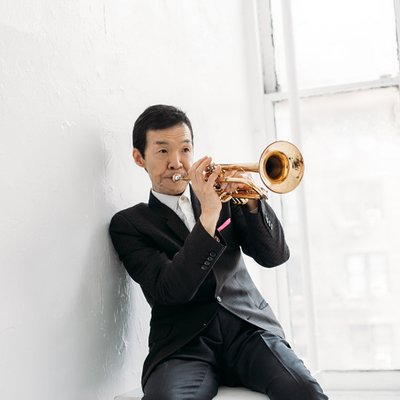
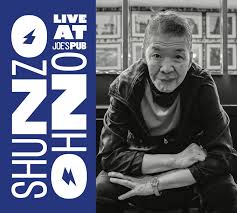
Trumpet master and composer Shunzo Ohno announces his anticipated album Live at Joe’s Pub. Drawing from live material captured during three evening-length concerts at the legendary New York venue, the album unveils Ohno’s range as a player, a career composer and a refreshing orchestrator — and his regenerating commitment to transmitting hope and beauty through his work.
Many colleagues consider Ohno a magician of the trumpet. Since his generation-spanning tenure as a key member of Art Blakey’s Jazz Messengers beginning in 1974, which led to pivotal associations with Roy Haynes, Machito, Larry Coryell and Gil Evans, as a member of their working bands, Ohno’s love for music, for composing and for fearless improvising has only intensified. Each of these legendary artists has influenced Shunzo’s artistry, both as mentors and cherished friends. Following a serious car accident in 1988 and a life-changing cancer diagnosis in 1996 that prompted the removal of 125 muscle structures and lymph nodes around his mouth and neck, he continues to reinvent his approach to playing his instrument as he pursues his forward-facing career as an innovator and a dedicated artist.
“Why I play music comes down to why I’m living today,” says the New York artist. “How am I able to live positively with a good vision for the future? I keep reminding myself, today, moment to moment, I need to live positively.”
Live at Joe’s Pub features performances that volley conversational moments and cinematic stories. Ohno’s working ensemble plays in concert with members of acclaimed string quartet, Lotus Chamber Music Collective (led by his daughter Sasha Ono), to develop narrative tension and create artful anticipation in each interlude. Together, the artists dissolve boundaries between what’s scripted and what’s spontaneous. And their willingness to take risks on the bandstand elevates both the dynamic sweeps and the natural expression of each composition.
The album opens on unity and warmth. The live series’ only folk-like tune, “Going Home” proffers an invitation for every member of every audience. “The audience always feels it’s a folk song from their home country,” says album producer Kazuko Ono. “A lot of Japanese people feel that song brings them home, a nostalgiatic spirit, but also Caribbean and some European people have shared the same sentiment, sharing, ’That song is from my country,’”. The melody begins with a quality of surreality before the tune enters a groove that may stray into uncharted dissonances but always resolves back home. “When we start with “Going Home”, says Ohno, “we’re able to connect with the [entire audience].”
In 2023, Ohno composed his first symphony, titled EPIC. For the Joe’s Pub performances, he re-orchestrates certain movements, adapting them for his small ensemble plus strings. Both “Vision” and “Heroic Dance” undergo an elegant shapeshifting that includes rearranging the French horn part for guitar, played by Quintin Zoto, creating a shimmer of interactive lines for the spirited string quartet to engage the powerhouse ensemble. Grounded in the story unfolding through Ohno’s trumpet, Clifford Carter’s piano solo soars; together they develop the narrative.
Live at Joe’s Pub spotlights seven of Ohno’s original compositions plus Beethoven’s Piano Sonata No. 14, the “Moonlight Sonata.” Ohno admits the process of developing the arrangement was tricky and painstaking. “I really had to digest ‘Moonlight Sonata,’” he says, “but the arrangement had to be me.” He chose the tune in particular for its beauty but also for its composer’s resilience and determination. “Beethoven’s life was so difficult,” says Ohno.
“He lived through multiple disabilities. He’ s like my hero — not only by the music but by how he lived.”
“Firefly” may be the shortest piece on the album, but its impact is massive and resonating. Composed for the 2003 film Fireflies: River of Light from Japanese director Hiroshi Sugawara. “Firefly” translates the story of a young girl searching for her deceased mother’s presence in the brightest firefly’s glow. The song layers harmony across moving strings, tinged at times with dissonance. “I made sure to capture the whole movie in three minutes of music,” says Ohno.”It’s really a tender story, and every time I talk about it, it brings a tear.”
Named for the power and determination of his youngest daughter’s field hockey team he witnessed at their daily practices, “Lea’s Run” incorporates a funky, laid back backbeat reminiscent of the hip hop tracks she would play throughout their household as a teenager. Jeremiah Edwards’ bass line drives a pulsing undercurrent alongside Thierry Arpino’s drums. “Young women running, individually, but also united, is an exhilarating force, a powerful momentum” says Ono. On piano, Noah Rott summons a free dance vibe.
Ohno frequently draws inspiration for his evolving expression from his native Japan. Since the historic earthquake and tsunami of 2011, he’s been traveling to the northern region of the country each year to visit the affected sites as the citizens continue to rebuild after seemingly insurmountable trauma and devastation. Opening with melodic colors from Zoto’s guitar, “Dreamers” is anthemic to both their challenges and resilience. “There is so much hope in this melody that I named this song for all dreamers,” says Ohno. “‘Dreamers’ means even in a hopeless situation we still need to hold a dream in our heart. That is what this song is for.”
The album concludes on a different kind of epic. Years ago, Ohno devoured a 10-volume set of novels sharing the story of the legendary warrior Musashi. Carter’s piano intro builds dramatically, with the full ensemble echoing a rhythmic euphoria. As each section unfurls, its small moments become an anticipation for the next, developing a riveting story of a dauntless spirit. “We have to keep fighting whatever obstacle is in front of us,” says Ohno. “That is the spirit of the Musashi.”
For Shunzo, that spirit burns brightest with a live audience. The shared breath, the charged silences, and exuberant outbursts exchange energy and elevate the music beyond the page. In that united space, resilience is felt, amplified, and carried forward.
With so much music behind him and so much more ahead, every day Ohno continues to recalibrate, recenter and reignite his hopeful spirit: “I feel profoundly optimistic for the future, even at this age and under these critical societal conditions. This is where we create a courageous renewed future. I hope this album is able to provide that kind of vision to the listener.”