
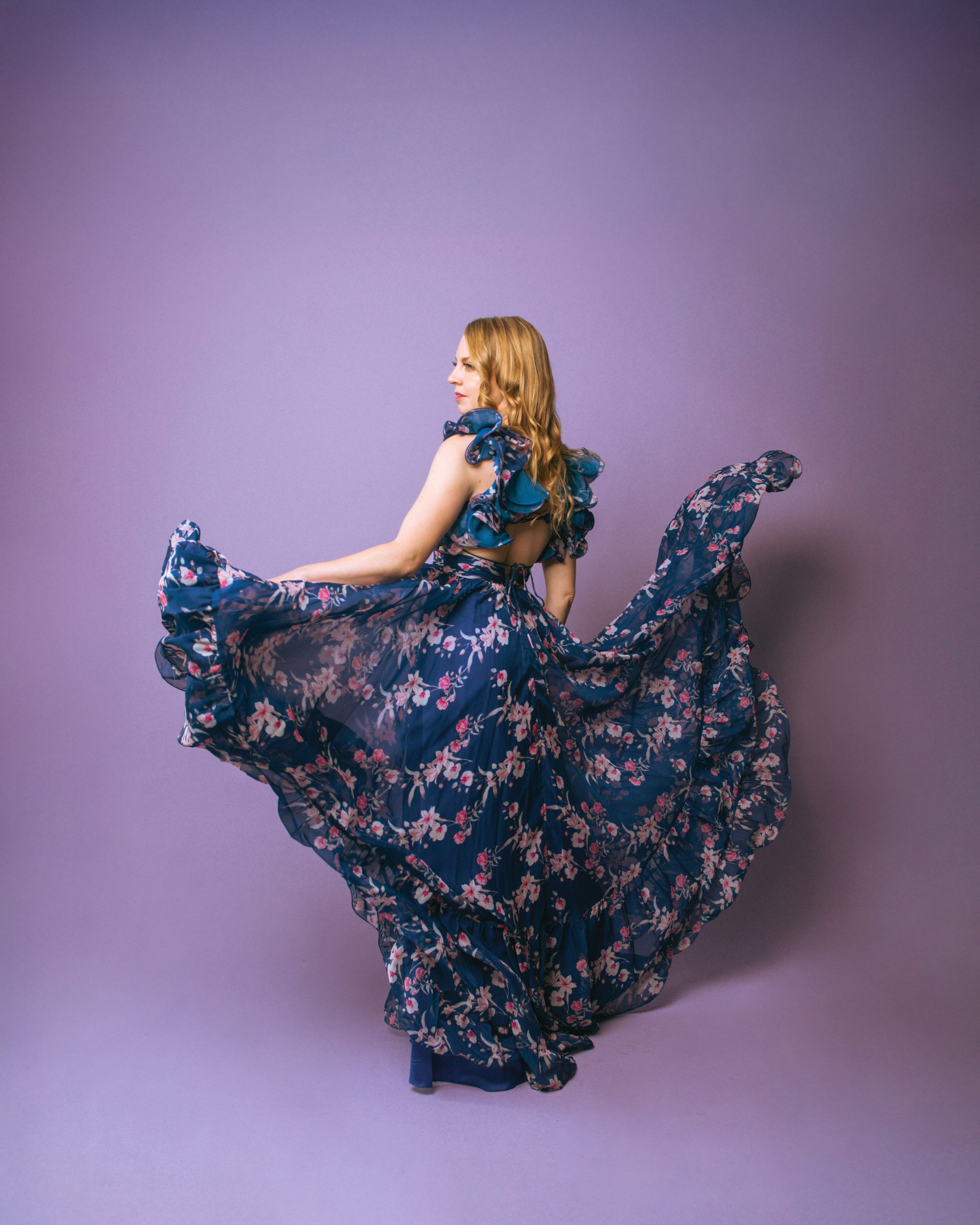

Vocalist and composer Aubrey Johnson crafts an experience of raw emotion and boundless artistry with her latest album The Lively Air, out March 20, 2026 via Greenleaf Music
Greenleaf Music is pleased to announce the March 20, 2026 release of The Lively Air, the second album from vocalist and composer Aubrey Johnson, featuring her six-piece jazz ensemble. An exquisitely crafted program of original arrangements and songs, the album marks Johnson’s return to composing after several years focused primarily on recording and interpreting other artists’ music (notably, Lyle Mays, Billy Childs, Alex Sipiagin, Randy Napoleon, and more). The album serves as a brilliant companion to her critically hailed debut, the 2020 Outside In Music release Unraveled.
The album opens with two revelatory originals. Propelled by the elastic pulse laid down by bassist Matt Aronoff and texturally acute drummer Jay Sawyer, “Hope” is a delicately feathered but acrobatic ode to optimism in the face of tribulations. Written as part of a commission from the Portola Vineyards Summer Jazz series, it encapsulates many of Johnson’s defining features as her liquid-mercury voice soars and swoops with breathtaking agility and she blends wordless vocal lines within the ensemble.
Moving into confessional mode, “The Words I Cannot Say” is a soul-bearing sojourn of emotional discovery, from wrath to rueful acceptance. Johnson wrote the piece at MacDowell and the arrangement makes brilliant use of her ensemble with Tomoko Omura’s violin seeming to coax and anticipate the journey toward resolution, while Alex LoRe’s bass clarinet evokes dark undercurrents of regret and dismay.
Writing for her ensemble, Johnson creates lush, shifting textural settings, favoring extended melodic lines whether she’s delivering a lyric or a wordless passage. She credits a Chamber Music America-supported mentorship with pianist and composer Billy Childs with helping her hone the band’s instrumental geography, creating arrangements where every instrument is calibrated around her voice.
“I like writing music that takes you on an emotional or dramatic journey, long-form pieces with an unusual number of sections or phrases,” Johnson says. “I keep myself open to whatever I’m hearing, and resist the temptation to do melody-solo-melody, though of course I do that sometimes too. Alex’s bass clarinet has such a beautiful, warm, round sound. I can have him doubling bass lines and low piano lines. And Tomoko can play arco or pizz, so I can almost write for two different instruments.”
Omura also contributes “The Miracle Is In Us,” an inventive piece that transforms text from Maggie Tokuda-Hall’s children’s book Love In The Library into an enthralling musical account of the author’s Japanese-American grandparents falling in love while interned during World War II. Bisected by a passionate dance between Omura’s violin and LoRe’s flute in a long central passage, the song reaches an ecstatic plateau as Johnson’s wordless vocals reach her upper register.
Johnson’s crystalline sound takes center stage with her reverent arrangement of Joni Mitchell’s “Help Me,” which ingeniously expands on the blueprint of the Court and Spark original. It’s a performance that affirms her deep affinity for Mitchell’s music (a relationship introduced with her liquid grace rendition of “Conversation” on her 2022 duo album with pianist Randy Ingram, Play Favorites). For sheer jaw-dropping fluidity, Johnson offers a joyous romp through “Chorinho,” a piece written as a tribute to Brazilian composer Egberto Gismonti by her late uncle, the great keyboardist and composer Lyle Mays (1953-2020). It was conceived as an instrumental, but Mays “challenged me to learn it for some performances we did back in 2010, and it has been with me since,” Johnson writes in the album’s liner notes.
Kurt Elling’s and bassist Rob Amster’s setting for Theodore Roethke’s poem “The Waking” is a duo tour de force for Johnson and Aronoff and provides fuel for its rise as a contemporary jazz standard. Her collaboration with her brother Gentry Johnson, “I’ll Never Need To Know,” is a strong contender for standard status itself. As part of the Portola commission she challenged herself to set someone else’s text to music, and after a long fruitless search for an appropriate poem she recalled that her brother had sent her one during the Covid lockdown. “We collaborated on the first album, but that was a song we wrote years ago, so it was fun for us to work together again,” she recalls. “The music was inspired a lot by Fred Hersch, a good friend and mentor whose music I’ve sung quite a bit.”
The album closes with another gorgeous composition by Mays, “Quem é Você” (Close To Home). She had always loved the tune, but it was only after Mays was gone that Johnson discovered the song’s Portuguese lyrics by Luiz Avellar, recorded by Milton Nascimento on his overlooked 1991 album O Planeta Blue na Estrada do Sol. It’s a big, sublime performance by Johnson, and another compelling example of her group’s powerful chemistry.
She arranged all the pieces, except Omura’s “The Miracle Is In Us,” but fmully credits her bandmates for their contributions. Omura and Aronoff have been part of the group since Johnson first assembled it for a residency at the lamented Cornelia Street Café. She has known Sawyer since they were undergrads together, and he took over the drum chair after the 2022 death of Jeremy Noller, to whom the album is dedicated. She knew LoRe from her graduate studies at New England Conservatory. Primarily an alto saxophonist, he stretched for the album. Pianist Chris McCarthy, who attended NEC after Johnson, rounds out the ensemble.
“The music is shaped around what they can do individually,” she says. “Chris McCarthy went to NEC after me and he’s brilliant. He can play anything. He had so much to add orchestrationally. Everything he plays is incredibly tasteful. I’m a pianist and I write from the piano, so finding him was a very important piece to making this happen.”
As on her first album, The Lively Air was co-produced and edited by bassist Steve Rodby, who worked extensively with Mays in the Pat Metheny Group, and mixed and mastered by Rich Breen. It’s the same production team she collaborated with on “Eberhard,” Mays’ 13-minute piece composed in homage to his mentor, the German composer and jazz bassist Eberhard Weber. Released the year after his death, the piece, which features Johnson on vocals, garnered Mays his 12th Grammy Award (for best instrumental composition).
“We’re carrying forward my family legacy,” Johnson says. “Lyle entrusted his estate to me and made it clear he wanted me to keep going. He was such a natural composer. He wrote all the time. It’s less natural for me, but something I love. It was so cool to work with Steve and Rich again, they’re the best team.”
With The Lively Air, Johnson continues to define her own sonic space, a realm of startling and unapologetic beauty.
The Lively Air will be available on March 20, 2026, via Greenleaf Music.
MORE ABOUT AUBREY JOHNSON Aubrey Johnson grew up in Green Bay, Wisconsin in the midst of a highly musical family. A passionate jazz fan, her father exposed her to the music’s foundational giants. Her mother, a fine pianist and singer, directed music at the church the family attended for many years. Lyle Mays was her mother’s brother.
At the age of six, Johnson decided she wanted to be a singer, an ambition that never waned. Beginning piano lessons at seven, she advanced quickly on the instrument and started studying jazz. When it came time for college, knowing she wanted to pursue music, she saw jazz or classical as her options, and decided to choose jazz at Western Michigan University in Kalamazoo, where she really fell in love with jazz.
“The first jazz singer I ever saw live was Dianne Reeves when I was in high school and she blew me away. I love Ella like most jazz singers, and Sarah Vaughan really resonated with me. Once I found Betty Carter, though, I knew I wanted to arrange crazier stuff. She was a huge influence. And listening to all the wordless vocal singing of Bobby McFerrin and the Pat Metheny Group’s music influenced my desire to develop in that direction.”
As an undergrad at Western Michigan University, Johnson studied classical and jazz voice and joined Gold Company, the university’s world-renowned vocal jazz ensemble. She made her auspicious recording debut on 2007’s Essence of Green (Origin Records) by pianist Ron DiSalvio with legendary drummer Jimmy Cobb. Western is also where she first connected with piano master Fred Hersch.
“He came to Western every semester to do private lessons, and studying with him was kind of life changing,” she says. “When I was graduating I didn’t know what to do and he recommended New England Conservatory, which was absolutely the right choice. Fred and I have stayed in touch, and I even had the chance to do two concerts with him subbing for Jo Lawry with his Pocket Orchestra.”
Starting her NEC master’s degree in jazz performance in 2007, Johnson studied with Danilo Perez, Jerry Bergonzi, Dominique Eade, Allan Chase, George Garzone, and Frank Carlberg. Upon graduating with honors she was awarded the Gunther Schuller Medal for “making an extraordinary contribution to the life of the school,” and won her third DownBeat Magazine Collegiate Student Music Award (for outstanding performance in jazz voice).
It was during her college years that she forged a deep musical connection with her uncle. While she grew up attending his concerts and listening to his music with Pat Metheny, Johnson didn’t get to spend much time with him during her childhood because he was always on tour. But when he heard that she was studying jazz he reached out and made time to mentor her.
In 2009 and 2010, she contributed wordless vocals and auxiliary keyboards for Mays, including concerts at the Zeltsman Marimba Festival and the Gilmore Keyboard Festival, where she performed several world premieres of pieces he composed with her voice in mind. By the time she made the move to New York City in 2011, Johnson had recorded with Bobby McFerrin on his Grammy-nominated album VOCAbuLaries (EmArcy).
While commuting to Boston to teach at Berklee she quickly became an essential new voice on the scene, performing with a daunting array of artists and ensembles, including Fred Hersch’s Pocket Orchestra, Sara Serpa’s City Fragments, John Zorn’s Mycale Vocal Quartet, Joe Phillips’ Numinous Ensemble, Andrew Rathbun’s Large Ensemble, Rose and the Nightingale, and Travis Sullivan’s Bjorkestra.
Among her fellow musicians, Johnson has carved out a singular reputation as the vocalist to call for the most daunting and intricate projects. In just the past year she has played an essential role on a bevy of stellar albums, singing on all tracks of lyricist and writer David Hajdu’s Lives of Saints (featuring compositions by Dave Douglas, Helen Sung, Renee Rosnes, and Johnson herself), trumpeter Alex Sipiagin’s Reverberations, composer Sasha Matson’s Little Woodstar, and drummer Alon Benjamini’s Universe. She has forged particularly deep ties with fellow vocalists, recording extensively with Manhattan Transfer veteran Janis Siegel, NEA Jazz Master Bobby McFerrin, and similarly intrepid peers such as Sara Serpa, Sofia Rei, Allegra Levy, and Michael Mayo.
As her reputation as a masterly vocalist spread, she turned into a source of inspiration for her colleagues. In regular demand, she has contributed to a series of distinctive projects that make canny use of her singular skill set, like Janis Siegel’s and Yaron Gershovsky’s The Colors Of My Life: The Music of Cy Coleman, guitarist Randy Napoleon’s The Door Is Open, composer and arranger Anthony Branker’s Songs My Mom Liked, vocalist Allegra Levy’s Out Of The Question, and flutist Jamie Baum’s What Times Are These.