
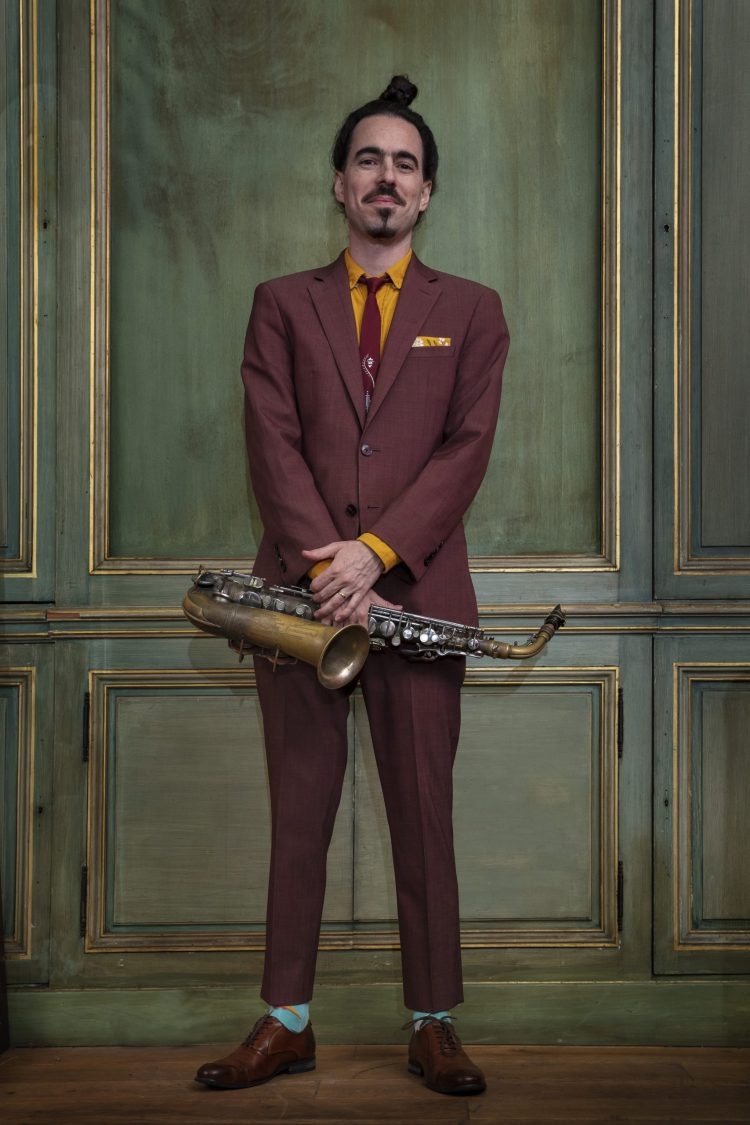

EYAL VILNER BIG BAND ANNOUNCES THEIR EIGHT NEW ALBUM — BIG APPLE STOMP — A FULL-SCALE, 18-TRACK STATEMENT FOR MODERN SWING-ERA BIG BAND
A high-voltage big-band snapshot of New York City—raw, swinging, and built to make you move.
Big Apple Stomp is the eighth album by the Eyal Vilner Big Band, led by saxophonist, clarinetist, flutist, composer, and arranger Eyal Vilner. Set for independent release on March 8, the album takes the listener on a journey through NYC big-band swing life. From a house party to a jazz club, from a Harlem ballroom to a Lower East Side speakeasy, from late night hangs to an afternoon street party, from the Express Tracks to the local. The album features original compositions alongside new arrangements of beloved standards performed by a core group of New York’s top musicians who have worked together across recordings, residencies, and international performances. The music is inspired by the connection between movement and sound within the world of jazz. “Jazz has such strong roots as dance music,” Vilner says, underscoring his belief in jazz as social music. “The beat and the groove are such an essential part of it. I wanted this record to feel like a jazz dance party.”
The album was recorded live, with all the musicians playing and grooving together acoustically in the same room, without headphones — leaving the listener with no choice but to join the party.
Born in Tel Aviv, Vilner moved to New York in 2007 and formed his big band the following year. Since then, the ensemble has maintained a steady presence in the city while developing an international profile through performances at Lincoln Center, the Guggenheim, Birdland, Dizzy’s Club, Smalls, The Joyce Theater, Minton’s Playhouse, Harlem Jazzmobile, Central Park SummerStage, LA Music Center and venues and festivals across Europe. Influenced by Johnny Hodges, Lester Young, Charlie Parker, and Benny Carter, Vilner exhibits a deep, warm, personal sound on the alto saxophone.
Big Apple Stomp kicks off with Horace Silver’s “Sister Sadie,” beginning on a strong anticipation beat. “We start with a Let’s Go!” Vilner says. “From the first note, it’s like an invitation. You’re invited to join this party.” Soloists Brandon Lee, Julieta Eugenio, Ron Wilkins, and Josh Lee pass the baton before returning to the ensemble. Duke Ellington’s “Drop Me Off in Harlem” follows with a stride piano introduction by Jon Thomas and a relaxed ensemble phrasing that showcases Vilner’s lead alto approach, with Wilkins and Vilner featured as soloists.
Vilner’s originals establish the album’s contemporary settings. “Snacking and Slacking” is built around two melodical motifs, a sharp crunchy line presented by the brass and a laidback motif played by the saxophones. Vilner gets to the soloist spotlight with a expressive scoopy note and develops his solo around the interplay between smearing notes and crisp, syncopated articulation.
“Play That Blues” hits the ground running: “No BS,” Vilner says. “We start heavy and grounded right on the downbeat.” The tune builds around Wilkins’ soulful plunger trombone and builds up into a climactic shout chorus based on a Louis Armstrong solo. “Express Tracks” is inspired by the hustling, bustling subway ride. “Always on the run, crowded, rushed, caffeinated anxiety, very NYC, but in an almost cartoon-like fashion,” Vilner describes. “You can hear the door closing, the horns honking, running up and down the stairs to the platform, and then every time [trumpeter] Brandon Lee solos over the bridge section of the song, it feels like we are on the train, catching our breath staring out the window daydreaming — then snapping out of it, running out the doors, and continuing the chase.”
Ellington’s “I’m Beginning to See the Light” introduces pianist Martha Kato and a shift in texture, showcasing Kato’s smooth piano touch and Josh Lee’s deep warm baritone sound. Horace Silver’s “The Preacher” draws on a New Orleans second-line groove and street-party energy, redolent of a sunny Sunday afternoon.
“Shout, Sister, Shout!” showcases vocalist Imani Rousselle’s versatile vocals, stretching from a theatrical storytelling to a soulful and sassy edge. With group clapping, sing-a-long, and call-and-response, the track feels like a party. Fats Waller’s “Honeysuckle Rose” presents two different styles of Harlem tradition. Pianist Jon Thomas opens with a sharp Monk-like stride piano, followed by the band playing the melody in a smooth, swing era style. Vilner plays a lyrical solo with a warm round alto sound while Thomas leans on a more stiff phrasing and intricate bebop harmonies. “The two worlds come together at the end of the shout chorus where the band modulates three times in half steps the way Bud or Tatum might do, but then bringing it back to a traditional Waller ending,” Vilner explains.
“Just You Just Me” opens with an elegant piano trio and features the power of a big band playing softly together. “The Tip Jar Blues,” inspired by a Lower East Side speakeasy gig, started from “a one-hand riff I made up while literally passing a tip jar,” Vilner laughs, it develops through call-and-response between the different sections and features John Lake and Julieta Eugenio.
“Sing Me a Swing Song (and Let Me Dance)” draws directly from Chick Webb’s Savoy Ballroom repertoire and features concise lyrical solos by Brandon and Josh Lee on trumpet and bari sax. “Battle Royal,” originally recorded on the Ellington-Basie battle-of-the-bands album, was arranged by Vilner for the Solo Jazz finals of the International Lindy Hop Championships in Harlem. It is dedicated to the new wind in today’s Lindy Hop scene and combines a hard-swinging big band sound with other grooves from the jazz continuum.
“Darktown Strutters Ball” features Rousselle on the vocals channeling young Ella Fitzgerald and the Savoy, making a trip up to Harlem while taking a little detour through New Orleans. Drummer Eran Fink changes gears on the band’s version of “Dinah” starting with early jazz aesthetics and Charleston-era rhythm and developing into a swing era feel, laying the ground to a formidable tenor solo by Eugenio.
Vilner’s “Went On and On and On” closes the core program. “It has ‘That’s all folks’ vibes,” he says.“Kind of like a chaser to wrap up the show and say goodnight.” The final two tracks are bonus cuts from an earlier recording by the extended version of the big band. “Let the Good Times Roll,” sung by powerhouse vocalist Brianna Thomas, carries an after-party-late-set feel, while Frank Wess’s “Once Is Not Enough” closes the album with a romantic comforting atmosphere featuring a warm sounding poetic alto solo by Vilner, a nod to Wess as a mentor.
“For us, playing this music is not about being nostalgic,” Vilner says. “It’s not about recreating another era. The beat, the groove, the dance, these are essential parts of the tradition of jazz music. But to me, it’s not only the history — it’s also the future of jazz”.