
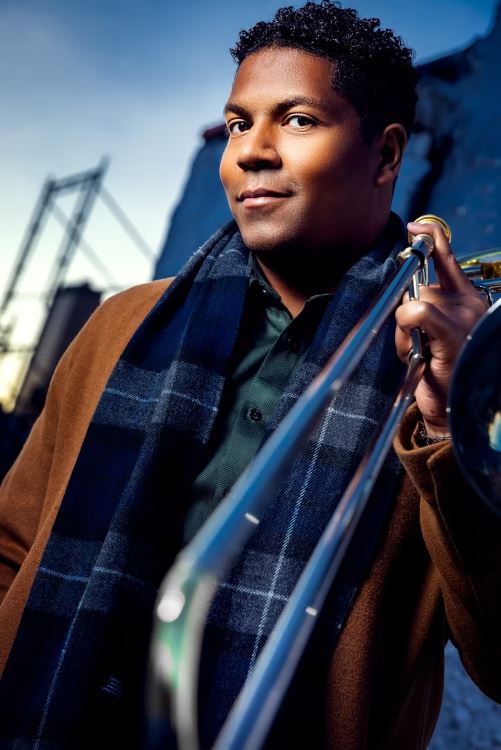

The Javier Nero Jazz Orchestra releases its sophomore album, Alkebulan, an exploration of diasporic lineage with a hopeful optimism towards a unified future, out March 20, 2026 via Outside In Music
Dr. Javier Nero represents far more than merely being a face of the top tier of jazz trombone. A lauded composer, educator, and acclaimed bandleader, Dr. Nero’s rapport has led him to perform sold-out sets at iconic venues such as Dizzy’s Club, Blues Alley, and Keystone Korner, and has made him a staple performer with everyone from Steven Feifke, the 8-Bit Big Band to the U.S. Army Blues. Now, hot off the heels of his big band debut, Kemet (The Black Land), the Javier Nero Jazz Orchestra presents Alkebulan, a concept album that dives into Dr. Nero’s diasporic roots while maintaining an optimistic outlook of cultural unity for the future.
The title of the album, “Alkebulan,” is derived from a contemporary anthropological theory of a unified, centralized ancient African society. In many ways linked to the spark that ignited Dr. Nero’s inspiration on his previous album, Kemet, the idea of Alkebulan is one of a precolonial cultural vibrancy that underpins the entire continent of Africa. This idea of unity, brotherhood, and vivacity enraptures Dr. Nero and set his writer’s pen ablaze. “This vision of an advanced ancient society where much of the knowledge is still lost or misunderstood to this day continues to invigorate my mind as an artist,” Dr. Nero says. Drawing from this idea of a pre-diasporic society, Dr. Nero set out to explore the ideas of unity and humanity across his own roots, expressions, and diasporic identity.
Dr. Nero notes that much of his fascination with and love for people, as expressed in his interest in the ideation of ancient civilization, came to a head in an entirely new way with the birth of his daughter, Zara Ayla Nero. Dr. Nero expresses profoundly that above and beyond all else, his daughter’s birth became the centerfold that bound all his work together, and evoked a more romantic side in his writing, seen prominently on the namesake compositions, “Radiant Flower (Zara)” and “Ayla”.
Dr. Nero cites a variety of key influences in his stylings as a composer. Growing up playing in and being exposed to the wind ensemble genre, Dr. Nero finds himself drawn to the vast soundscapes created by these often military-centered wind and brass ensembles, particularly the sounds of Alfred Reed and Gustav Holst, and seeks to utilize these timbres in similar ways. Dr. Nero also notes his place in the timeline of technological development as an influence. “As a millennial, I grew up at a time when the internet and technology was rapidly growing and influencing our culture,” Dr. Nero says. “As a result, video game music has played an unmistakable role in how I hear music and think about storytelling through music.” Dr. Nero notes that the medium of video game music taps into a “childlike wonder” that is indiscriminate in its audience, and draws in listeners regardless of whether it is hyper complex or powerfully simple. Dr. Nero praises the approachability of this genre and seeks to implement many of these same elements throughout his music. “I want to push the envelope musically, but never at the expense of making listeners feel uninvited to the party,” he says. “Everyone should be able to find something to relate to in my music and participate in the experience, whether they come to it with any prior musical training or not.” Dr. Nero also pays specific attention to the role of some of his earliest jazz influences – Duke Ellington and Billy Strayhorn – on this album, citing their touch in evoking much of the lush texturing and emotive power throughout the selection of pieces. Lastly, Dr. Nero cites the role of later iconic jazz groups as quintessential influences on his writing style, notably those stylings of The Pat Metheny Group, The Brecker Brothers, and Bob Mintzer.
The album’s title track, “Alkebulan,” was originally written in 2010 and is a project Dr. Nero has continually reworked. The version present on this album is a re-orchestrated edition that Dr. Nero sees as best exemplifying his amalgamation of styles. Containing jazz, classical, cinematic, and Afro-Latin inspired elements, “Alkebulan” follows a singable melody that traverses a complex environment of harmony and rhythm. Featuring solos by Warren Wolf and Sean Jones atop a solid rhythm section bedrock of Kyle Swan and Murph Aucamp, “Alkebulan” is a poignant highlight of the ensemble’s capabilities.
The aforementioned “Radiant Flower (Zara)” and “Ayla” draw heavily from the techniques and influence of Billy Strayhorn and Duke Ellington. Containing much more of the “traditional” big band sound, these heart-rending pieces capture both the deep love Dr. Nero feels for his daughter and the “beautiful chaos” that comes with having a newborn baby as life shifts to make way for a new child.
“Make It So” leans into the wide, sweeping aesthetic of the wind band to create sonic textures that Dr. Nero describes as “larger landscapes rather than tight sounds” with “anthemic style melodies.” This piece further ties into the themes of the album, using African-influenced rhythms placed atop modern jazz harmony.
A great part of this album’s beauty is its inherent collaborative element which spans all nine tracks. The assembly of an aptly-titled jazz orchestra is no mean feat, and yet Dr. Nero has succeeded in uniting an ensemble of highly skilled musicians who are equal parts brilliant and selfless, each of whom stand out and step back when the time is right to make something profound. This album’s big band cast comprises a powerhouse of: Daniel Andrews, Daniel Dickinson, Xavier Perez, Clay Pritchard, Lucas Pino and Dustin Mollick (woodwinds); Josh Kauffman, Chris Burbank, Graham Breedlove, Ken McGee, Noah Hocker, and Alec Aldred (trumpets/flugelhorns); Javier Nero, Luke Brimhall, Aaron Eckert, and Jake Craft (trombones); Adam Moezinia and Michael Kramer (guitars); James Collins and Alex Brown (piano); Kyle Swan (drums); Regan Brough (basses); Kyle Athayde (vibraphone); Danielle Wertz and Javier Nero (voice); and Murph Aucamp and Fran Vielma (percussion). The album also showcases a multitude of special guests: Randy Brecker and Sean Jones (trumpet/flugelhorn); Warren Wolf (vibraphone); Veronica Swift and Nicole Zuraitis (vocals); Shawn Purcell (guitar); and Nate Skinner (mallet station).
With Alkebulan, Dr. Nero successfully establishes himself and his orchestra as a force to be reckoned with. With a wealth of emotional depth, a myriad of stylistic variation, and a mastercrafted plan uniting the album thematically from start to finish, Alkebulan shows the trajectory of an artist set to grow ever greater and reach ever higher as he uses music to join, to invite, and to welcome audiences together.
